 Hero11










What the eleven is
Eleven means eleven names the contest will accept from the squads in that fixture. Not twelve with a note that you will “see at the toss”. Not nine stars and two blank places you plan to fill in the taxi. The create-team screen is the count. When it reads a full eleven and the save is allowed, you have a side. Until then you have a draft.
You should already know the match. Both sides, the format, the ground, the start, the lock on the room you will enter, and whether that room still has spots are the work of the pick a match page. Building an eleven for a room that is full, or for a lock you cannot beat, is how careful picks die in a contest you cannot join. Seats gone means that card is closed. The cricket can still be played. Open another card on the same fixture, or leave. A neater eleven does not create a seat. The match page writes that distinction in full.
The playing XI of the real teams is a different list from your eleven, and it matters more. Your eleven should be made of people who are in that XI, or who you still have time to remove if the sheet drops them. If the announcement has not been made and the lock is close, you are guessing. Guessing is one of the reasons to stop, written on the first guide. If the sheet drops a name while you can still edit, replace the name. If the room has already closed, the saved eleven is finished.
The role tabs
A cricket create-team screen can label roles as WK, BAT, AR, and BOWL. The sample on this page uses those tabs. Walk them in the app you have open. Do not invent an extra quota this page never stated. Follow the counters on the screen. If a save is blocked, the team is short of a role the contest requires, or it has broken another limit that contest enforces. The message on the screen is the rule. A habit from another app is not.
WK is the wicketkeeper label. The batting slot is the real question. A keeper who opens will face the new ball. A keeper who bats at seven or eight in a T20 may face very few deliveries if the top order stays in. Both can be honest picks. They are not interchangeable just because the tab is the same. Pick the keeper whose recent role matches the innings you are trying to cover. If you leave the WK tab empty and the screen then refuses the save, you are short of a role that contest requires. Fill what the counter asks. Do not add a second keeper because a group chat said every side must look a certain way.
BAT is where the specialist batters sit. Top order and middle order do not share the ball. On a day when early wickets fall, the middle order faces the crisis and sometimes the death. On a day when the openers bat through, the finishers can watch. You cannot know which day it will be. You can avoid selecting four openers who cannot all face the new ball, and you can avoid a middle order made only of names who have not batted in the top seven for weeks. Recent role, not one viral inning, is the filter you already used when you picked the match. Keep using it here.
AR is the all-rounder label. Both skills have to be live. If the real captain has stopped bowling a player, that player is a batter until the overs return, whatever the tab says. If a batter bowls two overs of fill-in spin once a month, do not count those overs as a bowling plan for this ground. Whether a player who bats and bowls should wear the chair comes later, and only if this match still gives that player both a batting slot and a real spell, with the player in the side that walks out. That decision waits until the eleven exists. It is written on the captain page. Do not hand out the title while you are still filling the tab.
BOWL is the specialist bowling label. Split it by phase in your own head: new ball, middle overs, death. Four quicks who all want the same six overs are not a bowling innings. A spinner who bowls the middle, at a ground that has taken turn, is a different pick from a spinner who is in the squad and does not get the ball. If the app shows a pitch line, let it interrogate this tab. The match page records the sort of surface sentence a layout can carry. This match may show a different sentence, or none. A pace note is a reason to check which quicks have the new ball and which have the death. It is not a reason to delete every spinner, and a batting-friendly note is not a reason to empty the bowling tab. The counters will not treat eleven batters as a complete side if the contest does not allow that shape.
Balance, without a scoring chart
This page does not keep a points table. The contest scores the match under the rules printed on that contest. Your job is narrower: the eleven should still have a way to be involved if the top order fires, a way to be involved if the top order fails, and bowling that exists in the phases this ground and this pitch line, if any, are likely to feature. That is balance. It is not a formula with a total at the bottom.
Read the eleven back once, tab by tab, and ask who faces balls and who bowls overs. If three of your batters need the same powerplay, two of them may do very little. If all of your bowlers need the death, the middle overs are a hole. If every name is from the side you hope will bat first, remember you do not control the toss, and a locked entry cannot be rebuilt after the coin. Cover both teams unless the counters stop you. Stacking one real team past the counter is a refusal waiting to happen, not a bold opinion.
If a credit total is on the screen, stay inside it. The screen will refuse an illegal team. You do not need a second budget written on a scrap of paper in numbers this contest never showed you. When the save fails, read the counter and the message. Fix that. Do not invent a salary cap, and do not import one. The contest’s rules also show captain multipliers. Another app’s habit is not this contest’s number. Leave the titles until the eleven saves.
A differential in a large room
A differential is a player fewer people in that room will pick. In a large room it can separate your eleven from a crowd that has chosen the same stars. It is useful only when you have a reason tied to role, venue, or team news. The reason has to be sayable in one sentence. “The regular spinner is rested, this bowler takes the middle overs, and this ground has helped spin in this competition.” That is a reason. “The pick percentage looks small” is not a reason. A low number is a description of other people. It is not a description of the cricket.
Tie the differential to a job you already needed. You needed a death bowler, and the famous one is doubtful, so you take the bowler who actually bowled the 18th over last game. You needed a middle-order batter because your top order is already full, and the player batting at five has been in that slot for a month while the crowd still selects the opener. You do not need a tailender with no batting slot and no overs, picked only so the eleven looks unusual. Unusual and unused is a wasted name.
Check the differential against the playing XI as strictly as you check a star. A clever pick who is left out scores nothing and cannot be swapped after lock. If you are not sure the player plays, the differential is a worse pick than an ordinary player you are sure about, not a better one. Fame is a weak reason to captain someone. Obscurity is a weak reason to select someone.
Small rooms and a head-to-head
A small room and a head-to-head do not pay you for being unusual. You are trying to beat one other team, or a short list of teams. Prefer players who are in the playing XI and have a clear role. The keeper who actually keeps and bats in a known slot. The bowler who bowls in a known phase. The batter who has a place in this batting order, not a place in last year’s final.
You do not need a clever differential to beat one other team. If the other person picks the correct XI and you pick a cute miss, the cute miss has to have a remarkable day just to draw level with an ordinary innings from a player who was always going to play. In a two-team contest, matching the side that takes the field is the whole skill. Save the unusual name for a large room where you can explain it with role, venue, or news.
The room type does not change the counters. A head-to-head still refuses an illegal team. It still has a lock. It still shows, on that contest, how many teams you may submit. Do not invent that number. Read it. If it says one, one careful eleven is the entry. Changing it while the room is open rewrites that entry. You stay entered. The change does not quietly add a second eleven.
Mistakes
These are the errors that survive even when the match was a fair one to enter. Each of them is a way to arrive at lock with an eleven you would not defend out loud.
- Picking from last season’s memory. The batter who opened two years ago may be batting at six now. The bowler who took a five-wicket haul on a green pitch in a different competition may not be in this squad. Recent role is the last several matches in this format. A poster from a previous tournament is not a squad list.
- Ignoring the lock timer. The broadcast start is not the lock. Building a beautiful side in a room that closed while you were still on the BAT tab leaves you with nothing to join. Read the timer on the contest you will enter before you fall in love with a combination, and stop if it is too close to read the pitch and the XI.
- Stacking one real team past the counter. Supporting one side is not a team-building rule. If the screen stops you, you have passed a limit that contest enforces. Take a player off that side and cover the other XI. The refusal is the instruction. Arguing with it does not raise the counter.
- Leaving a role tab empty. WK, BAT, AR, and BOWL are there to be used as the screen requires. An empty tab feels like a decision and is often just a forgotten tap. If the save is blocked, look for the short role before you look for a conspiracy. Follow the counters.
- Naming the captain before the playing XI is announced. The title is the last act inside this step, and only for a player you are sure will play. Do not give the chair to a star batter the bulletin has not cleared. If you pin the title early, the rest of the eleven turns into a tribute, and a late omission forces a rebuild under a clock you already wasted.
- Copying a public eleven you have not checked against the pitch. A list in a chat, a screenshot from a friend, or the sample picture on this page is someone else’s layout or someone else’s opinion. It does not know your room, your lock, or whether this app is even showing a pitch line today. Check every name against role, venue, and team news. If you will not do that, do not paste the list.
The sample screen is a layout
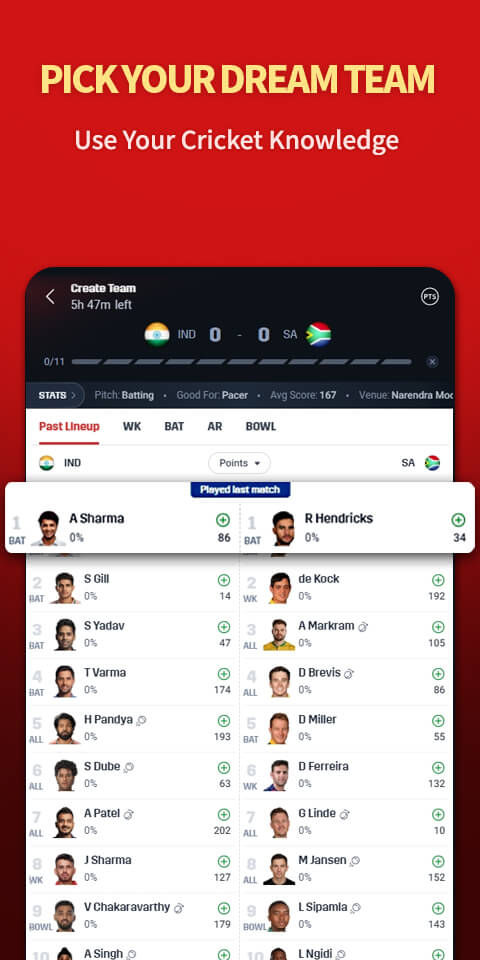
Look at the picture for the furniture, then look away. You can see two sides, a progress counter that starts empty, role tabs a create-team screen can offer, and a pitch note of the kind a sample has shown, in the family of batting-friendly or pace. That note belongs to the sample. Your match may print a different line or none. The venue line on the sample is part of the same picture. It is not an instruction to build for that ground tonight.
Do not copy the names. Do not wait for the timer in the picture, and do not treat that countdown as the time left on your room. Do not treat a counter sitting at 0/11 in a photograph as your counter. Your screen will move as you add players. When your own counter and your own lock are in front of you, go back to the tabs, then set captain and vice-captain last. If the screen refuses the save, note the tab, the counter, and the message, and use the contact page if you need a person. The FAQ answers the short version of the sample question directly: no, you should not copy that team.